Concrete removal and replacement in Roanoke, VA
If it's cracked, sunken, or gone soft, it comes out.
Some concrete can be patched. Some of it needs to be broken up, hauled off, and poured again the right way — new base and all. We'll tell you straight which one your job needs.
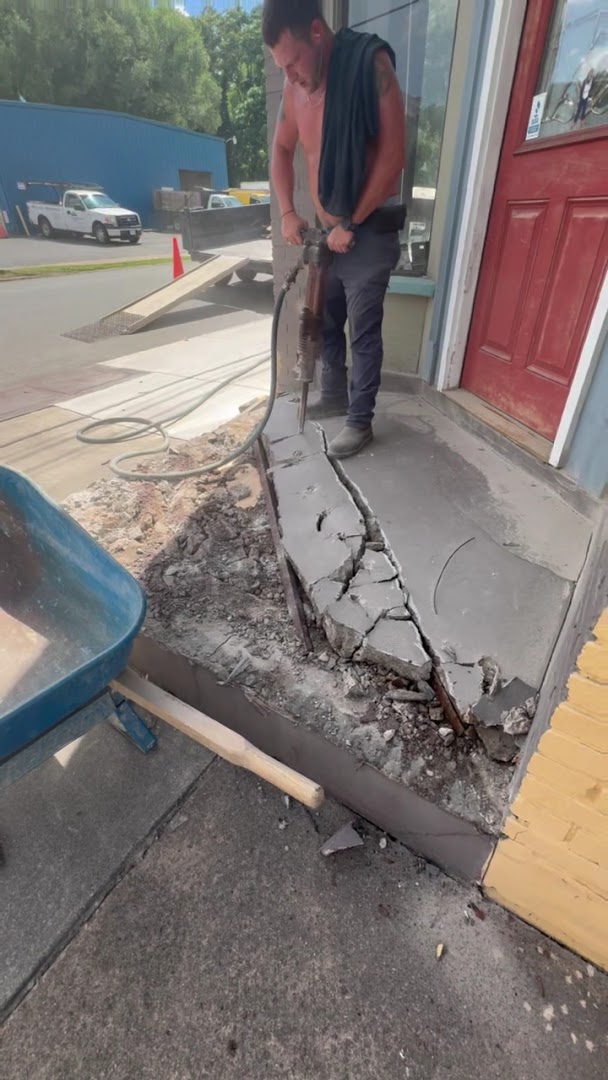
What tearing out old concrete actually involves
Removal is the part most people don't think about until they're standing on a driveway that's heaved three inches or a patio that's sunk on one corner. Before we quote it, we need to know why it failed — a slab that cracked because of a tree root close to the surface is a different job than one that settled because there was never a real gravel base under it. We check both before we say what it'll take. Once we're on site, the old concrete gets broken up with equipment, loaded, and hauled off — that's most of the labor and most of the time on a removal job, especially on a full driveway where the slab is 4 to 6 inches thick and reinforced with wire mesh or rebar that has to be cut free. Underneath, we're looking at the subgrade: is it compacted, does it drain, is there old asphalt or debris buried in it from a prior pour. Roanoke's clay soil doesn't drain fast, and a lot of the cracked slabs we tear out cracked because water sat under them through a few freeze-thaw cycles. What goes wrong when this is done badly is almost always in that step nobody sees. New concrete poured over an uncompacted or poorly graded base will crack and settle again, sometimes within a year, no matter how well it's finished on top. Skipping control joints, or cutting them in the wrong spots, means the concrete cracks where you don't want it instead of where it's supposed to. And matching height and slope to a driveway apron, a garage floor, or an adjoining walk sounds simple until it isn't — get it wrong and you've got a trip hazard or water running toward the house instead of away from it.
Tell us about your jobHow a removal and replacement job goes
This work has more steps hidden underneath than a fresh pour on open ground. Here's what actually happens between the quote and the walkthrough.
- 01
Look at why it failed
We check the cracking pattern, any settling or heaving, drainage around the slab, and whether there's a root, a pipe, or a bad base underneath before we tell you what's needed.
- 02
Break it up and haul it off
The old concrete gets cut free of anything it's tied into, broken out, loaded, and hauled off site. On a driveway or garage floor, this is usually the biggest chunk of time on the job.
- 03
Fix the base, not just the top
Low spots get filled, soft ground gets compacted, and drainage gets corrected before any new concrete goes down. This is the step that decides whether the new pour lasts.
- 04
Form, reinforce, and pour
Forms go in to match the height and slope of whatever it's tying into — a garage floor, an existing walk, the street. We place reinforcement, pour, and finish it broom, smooth, or to match what's around it.
- 05
Cure, then walk it with you
We give the new concrete the time it needs before it takes weight or traffic, then walk the finished area with you and clean up the site before we go.
Where we tear out and replace
Questions before you tear anything out
Will the new concrete just crack the same way the old slab did?
Not if we fix what caused it. We look at the base, drainage, and any roots or soft ground before we pour, so the new slab isn't sitting on the same problem the old one was.
What happens to the old concrete you remove?
It gets broken up, loaded, and hauled off site as part of the job — you're not left with a pile of broken concrete to deal with.
Do you have to remove the whole driveway or slab, or just the bad section?
Depends on where the cracking or settling is and how it's tied into the rest of the slab. Sometimes a section can be saw-cut and replaced on its own; sometimes the whole thing needs to come out to get a clean, level result. We'll tell you which one your job needs and why.
Will my new sidewalk need a permit since it's near the street?
Some replacement work near the right-of-way does need a permit depending on the location. We'll tell you if yours does and handle the paperwork.
How long before I can drive on it or walk on it?
New concrete needs time to cure before it takes weight or traffic. We'll give you the exact timeline for your job based on the pour and the weather.
What areas do you handle removal and replacement in?
We're based in Roanoke, VA and take on removal and replacement jobs throughout the surrounding area. Call or text with your address and we'll let you know.
Ready to have it torn out and done right?
Tell us what's cracked, sunken, or failing — driveway, patio, sidewalk, or slab. We'll take a look and give you a straight answer.
Call (540) 384-9297